Link strength: who links to you, and does it matter?
A link is a recommendation. We show who recommends you, and who is just making noise.
Your whole link profile, with the spam filtered out and the gaps pointed out.
What is a backlink, and why does it count?
A backlink is a link from another website to yours. Google reads it as a recommendation: if many trustworthy sites have linked to you, you must be worth showing. It is still one of the heaviest factors in how high you rank. But the count alone says little: one link from a major news site weighs more than a hundred from pages nobody reads.
What is anchor text, and why does it come first?
Anchor text is the words that have been made clickable. If someone writes "read more" and links to you, Google learns nothing about what you do. If they write "web agency in Aarhus", Google gets a piece of information about what your page is about, and it comes from a third party, which weighs more than when you say it yourself. We collect all your anchor texts and show which words others use about you. If most of them are "click here", there is something to gain.
What do I do about spam links?
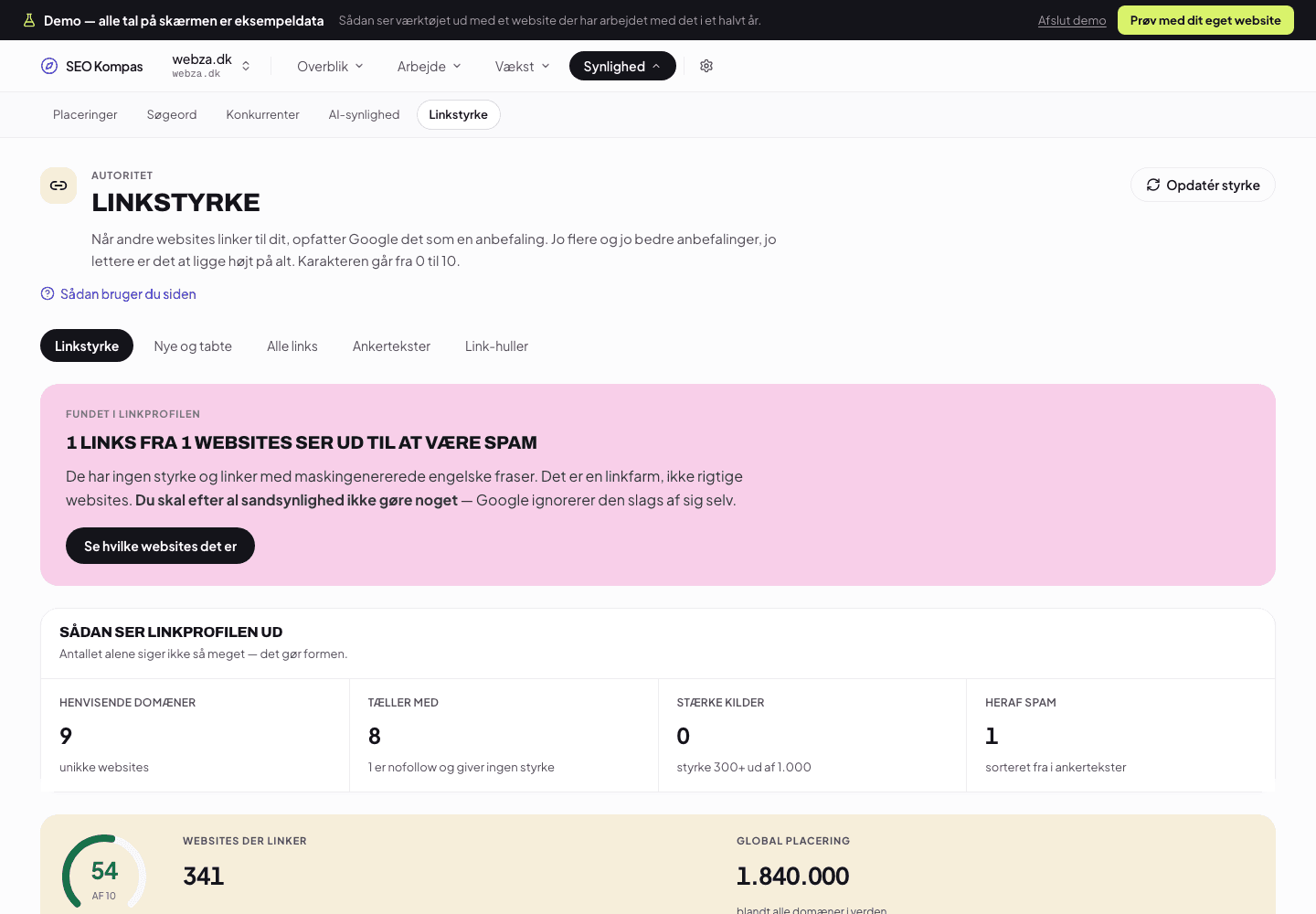
In the vast majority of cases you do nothing about spam links. Link farms and auto-generated pages link to thousands of websites without asking, and for years Google has ignored them instead of penalising anyone for them. The problem is a different one: they pollute your own numbers. Eleven links, eight of which are spam, look like eleven recommendations. We know the patterns and filter them out, so anchor texts and strength are calculated on the links that actually count.
What is a link gap?
A link gap is a website that links to several of your competitors but not to you. It is the most obvious list to work from, because those sites have already shown that they write about your field and link out. We compare your link profile with the competitors you have chosen and list the domains you are missing.
You do not get a list of a thousand links. You get the three you can do something about.
- 1See which websites link to your competitors but not to you. They already write about your field.
- 2Look at your anchor texts: if it says "click here" where it could say what you do, ask to have it changed next time.
- 3Leave the spam links alone. They are filtered out of your numbers, and Google ignores them anyway.
And the next time we go through the website, we check for ourselves whether it was done.
Questions and answers
- Where does the link data come from?
- The link data comes from DataForSEO, which maintains its own index of links across the web, plus OpenPageRank for the domain strength itself. It is fetched once a week, because a backlink does not change between morning and afternoon.
- Can I see links that have disappeared?
- Yes. Lost links are listed separately with the date they were last seen. A link that disappears from a strong site is often the reason a ranking dropped, and without the list you would go looking in the content instead.
- Should I buy links?
- We do not recommend it, and the tool does not help with it. Paid links go against Google's guidelines, and the patterns found in link farms are exactly the ones we use to flag spam.
Try it on your own website
Enter your domain. We fetch the home page and take a look, free and without logging in.
Free and without login. We fetch your homepage and take a look. It takes a couple of seconds.
See what the check looks for before you enter your domain.
The rest of the tool
Keywords and rankings
Search Console shows what happened. We show what to do about it.
Read more
Technical health
We go through every single page, not just the home page. And we say who needs to fix what.
Read more
Task list
Not a report you have to interpret. A list you can work your way down.
Read more
Growth plan
Most SEO tools stall at zero. This is the plan that comes before.
Read more
AI visibility
Ranking number one is no longer enough. Someone has to cite you.
Read more
Reports
For the boss, the client or the board, without anyone having to log in.
Read more