Keywords and rankings: see what people find you for
Search Console shows what happened. We show what to do about it.
All your searches, sorted by how many clicks there are to gain.
What is the difference between a keyword and a search query?
A search query is something a person typed into Google, and a keyword is something you have chosen to keep an eye on. Search Console gives you the queries: every time you were shown, whether or not you had ever thought about that phrase. That is typically many hundreds, and for most of them you have never written a page. Tracked keywords are the short list you have picked yourself, where we measure your position every week and store it, so you see a curve instead of a snapshot.
Why does position 11 matter more than position 3?
A page in position 11 is only a short climb from page one, and that makes it worth more of your time than a page already in position 3. It sits at the top of page two and gets almost no clicks, but it has already proven to Google that it belongs on that keyword. Moving it up three places is often a couple of hours of work. Moving a page from position 40 to page one is six months of work. We collect the pages in positions 4 to 20 separately and work out how many clicks each one would gain if it moved up.
What does it mean when two pages compete for the same keyword?
It means you are competing with yourself. If you have both a product page and a blog post about "seo optimisation", Google picks one of them, often the wrong one, and the links, the text and the authority are split across two pages instead of building up on one. We find those cases automatically by looking at which searches show more than one of your pages, and we say which of them should win.
What do I do once I have seen the number?
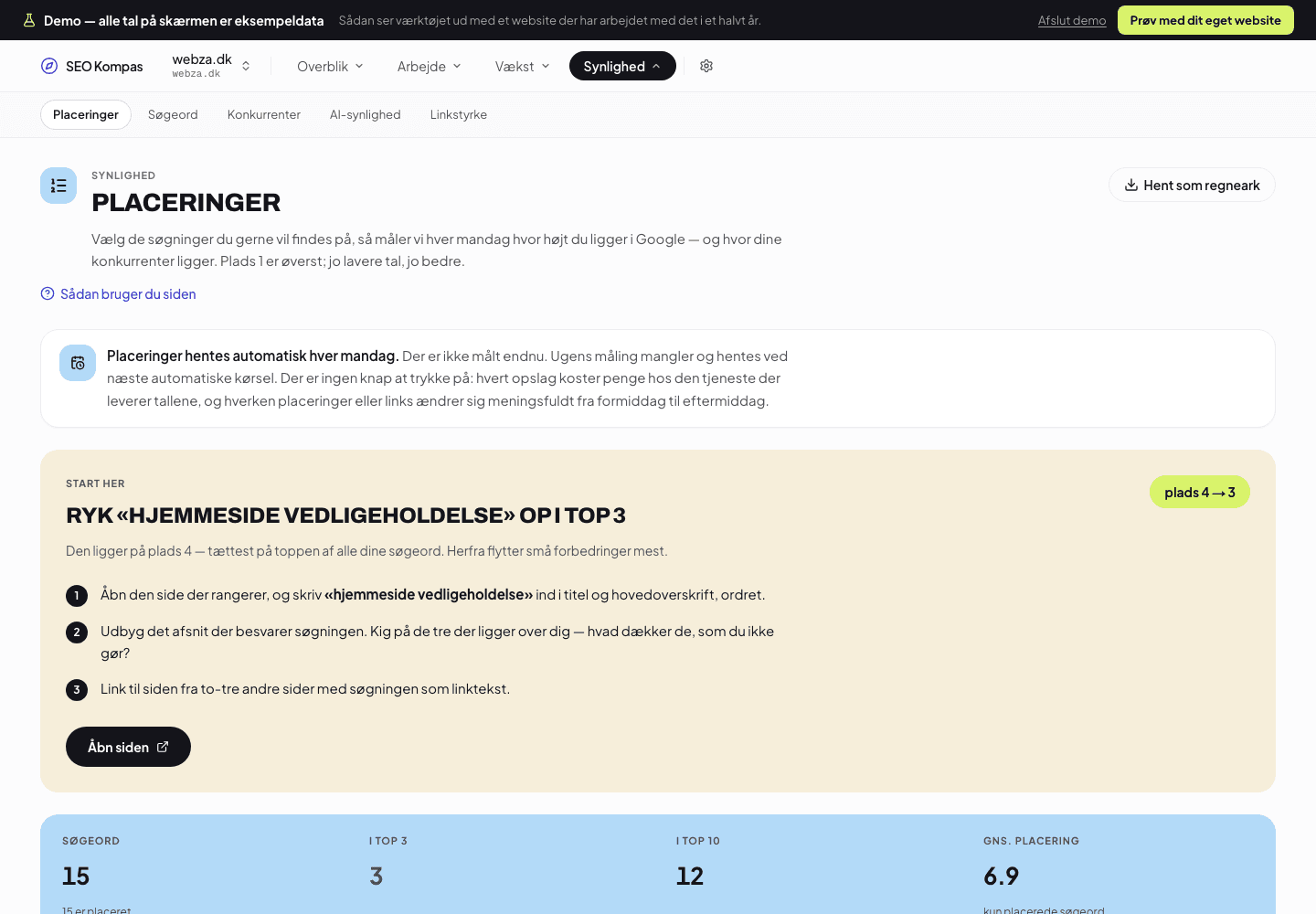
You are told what to do. That is the difference between this and a report: at the top of the screen there is one place to start, with the page, the search query, and three concrete steps in the order they should be done. "Write the search query into the title and main heading, word for word." "Expand the section that answers the query." "Link to the page from two or three other pages." There is a button that opens the page in question, so you do not have to go looking for it. And the next time we go through the website, we check for ourselves whether it was done.
How often are rankings measured?
Rankings are measured once a week, on a fixed day. Not more often, and that is a choice. Rankings move from day to day depending on where the user searches from, which device they use, and what Google happens to be testing. A daily measurement gives a jagged curve you cannot read anything from. A weekly one gives a line that actually shows whether the work is paying off.
You do not get a number. You are told what to do.
- 1Open the page that ranks, and write the search query into the title and main heading, word for word.
- 2Expand the section that answers the query. Look at the three results above you: what do they cover that you do not?
- 3Link to the page from two or three other pages, with the search query as the link text.
And the next time we go through the website, we check for ourselves whether it was done.
Questions and answers
- Can I see rankings for keywords I have not started tracking?
- Yes. Search Console gives an average position for every search you have been shown for, and it is displayed for all of them, including the ones you have not picked. If you track a keyword, you also get a precise measurement every week and a curve over time.
- Why is my ranking in the tool different from what I see in Google myself?
- Because what you see is your own search: your location, your search history, your device. The number in the tool is an average across all the times the page was shown, measured from a neutral position. Your own result is almost always better than the average.
- How many keywords can I track?
- 75 on Starter, 150 on Lite and 800 on Pro. The limit is not technical: every tracked keyword costs a measurement at our data provider every week, and the plans are put together according to what that actually costs.
Try it on your own website
Enter your domain. We fetch the home page and take a look, free and without logging in.
Free and without login. We fetch your homepage and take a look. It takes a couple of seconds.
See what the check looks for before you enter your domain.
The rest of the tool
Link strength
A link is a recommendation. We show who recommends you, and who is just making noise.
Read more
Technical health
We go through every single page, not just the home page. And we say who needs to fix what.
Read more
Task list
Not a report you have to interpret. A list you can work your way down.
Read more
Growth plan
Most SEO tools stall at zero. This is the plan that comes before.
Read more
AI visibility
Ranking number one is no longer enough. Someone has to cite you.
Read more
Reports
For the boss, the client or the board, without anyone having to log in.
Read more