AI visibility: are you cited by ChatGPT and Google's AI answers?
Ranking number one is no longer enough. Someone has to cite you.
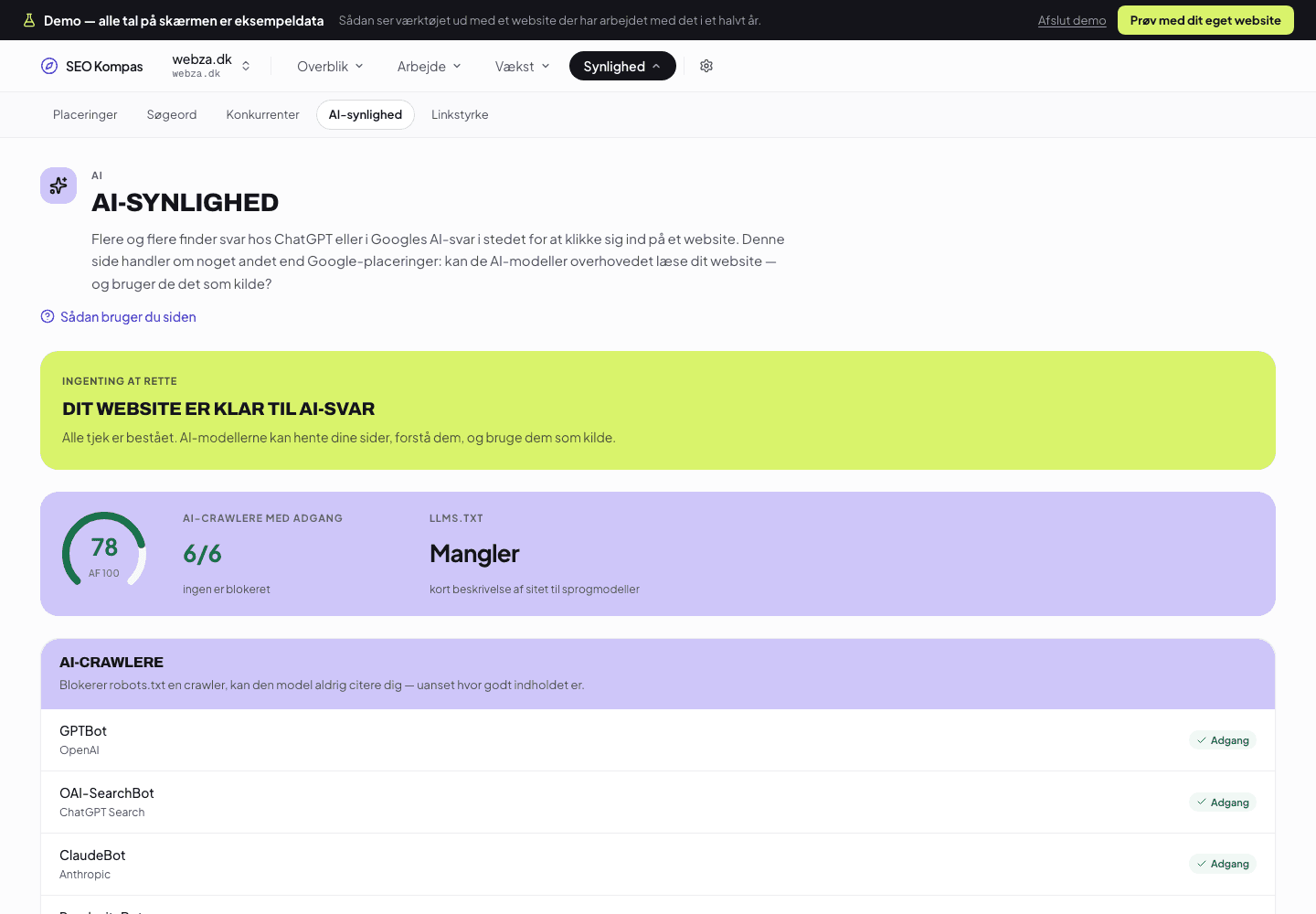
We check whether the AI crawlers have access, and whether Google cites you in its AI answers.
What is the difference between SEO and AI visibility?
SEO is about ranking high in a list of ten blue links, while AI visibility is about being used as a source in the answer above the list, or in ChatGPT, where there is no list at all. You can rank number one and never be cited, and you can rank number twelve and be cited every time. That is why the two are measured separately.
What stops an AI from using my website?
Most often it is robots.txt. If it blocks GPTBot, ClaudeBot, PerplexityBot or the others, that model can never cite you, no matter how good the content is. Many websites block them without knowing it, because a plugin or a developer added a rule to "protect the content". We check every single crawler and say which ones are shut out.
What is llms.txt?
llms.txt is a short file that describes what the website is and where the important content lives, written for language models instead of for people. It is not a standard anyone enforces, and it comes with no guarantee. But it costs one file, and it makes it easier for a model to understand what you do without digging it out of a home page full of headlines.
Do you measure whether I am actually cited?
Yes. For each of your tracked keywords we look at whether Google shows an AI answer, and whether your domain is listed as one of the sources under it. That gives a number you can follow: "cited in 5 of 10 AI answers". That is something other than guessing from whether the content looks well written.
First the access. Then the content. In that order.
- 1Check whether any AI crawler is blocked in robots.txt. It is the one thing that makes the rest irrelevant.
- 2Write an llms.txt that says what the site is and where the content lives.
- 3Build the pages as questions and answers, so a section can be cited without having to be understood in context.
And the next time we go through the website, we check for ourselves whether it was done.
Questions and answers
- Should I shut the AI crawlers out to protect my content?
- That is your decision, and there are arguments both ways. But be clear about the consequence: a model that is not allowed to fetch your website cannot refer to it either. For most businesses it is a channel, not a theft.
- Can you measure ChatGPT directly?
- No. We measure Google's AI answers, where the sources are visible, and we measure whether the other models' crawlers have access. There is no reliable way to ask ChatGPT how often it mentions a particular domain.
- Does it help to write content "for AI"?
- What helps is what also helps a person: a clear question as the heading, an answer that can stand alone in the first sentence, and numbers written in the text instead of in an image.
Try it on your own website
Enter your domain. We fetch the home page and take a look, free and without logging in.
Free and without login. We fetch your homepage and take a look. It takes a couple of seconds.
See what the check looks for before you enter your domain.
The rest of the tool
Keywords and rankings
Search Console shows what happened. We show what to do about it.
Read more
Link strength
A link is a recommendation. We show who recommends you, and who is just making noise.
Read more
Technical health
We go through every single page, not just the home page. And we say who needs to fix what.
Read more
Task list
Not a report you have to interpret. A list you can work your way down.
Read more
Growth plan
Most SEO tools stall at zero. This is the plan that comes before.
Read more
Reports
For the boss, the client or the board, without anyone having to log in.
Read more